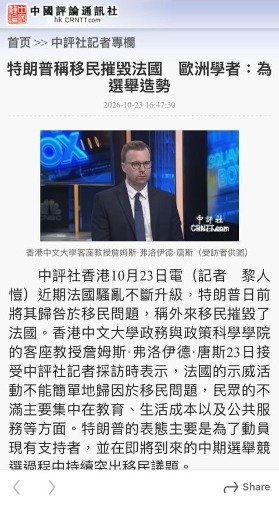
Rise of Populism in Europe and the Upcoming US mid-Terms
The Director of the Europe-Asia Programme at CERSP Prof. James F. Downes was interviewed by China Review News Agency on the important topics of the recent French protests, the rise of Populism in Europe and the upcoming US Mid-Terms.
Prof. James F Downes Interview:
Amid escalating unrest in France, Trump recently blamed it on immigration, claiming that immigrants have destroyed France. James F. Downes, an Adjunct Professor at the School of Government and Policy Science at The Chinese University of Hong Kong, told a reporter from China Review News Agency on the 23rd of October that the French demonstrations cannot be simply attributed to immigration. Public discontent is primarily focused on education, cost of living, and public services. Trump’s statement is mainly aimed at mobilizing existing supporters and continuing to highlight the immigration issue in the upcoming midterm election campaign.
Dr. James F. Downes is the Director of the Europe-Asia Programme at CERSP, a Think Tank in the United States. He also serves as an Adjunct Professor at the School of Government and Policy Science at The Chinese University of Hong Kong and an Honorary Research Fellow at the Hong Kong Institute of Asia-Pacific Studies at the Chinese University of Hong Kong. He is a leading scholar on party politics, populism, and immigration issues in European countries.
According to the Global Times, after the French unrest broke out, Trump and US Vice President Vance immediately blamed it on France’s immigration policies, claiming that immigrants are “full of hatred” and “destroyed France.” Trump believes the current riots in France, Italy, and other European countries are related to illegal immigration, and that if the Democrats win the US midterm elections, the riots could be repeated in the US.
US President Donald Trump stated at the White House on Monday, “If Europe doesn’t close its borders and doesn’t get the criminals out, like the people protesting, Europe is finished.” “When I see France, when you see Italy, when you see all the riots and hatred, it’s not about schools. It’s about people going into a country that hates this country.”
Downes stated that immigration has become a major political issue in Europe and the 27 EU member states. Opinion polls and surveys conducted in most EU countries clearly reflect this. However, the situation in France is complex and cannot be simply attributed to immigration. Therefore, we should not confuse discussions about immigration with the actual causes of this social unrest.
Downes pointed out that based on current news reports from France and across Europe, there is insufficient evidence to suggest that immigration is the primary trigger for the violence in France. Existing records show that public discontent is mainly focused on education, cost of living, and public services.
Downes emphasizes that Trump’s claim that “Europe is finished” is more of a political rhetoric than a convincing policy analysis of the current social unrest. Trump’s remarks conflate immigration, peaceful protests, and criminal violence, while ignoring public discontent over education, public services, and the cost of living. While those who commit violence should be held accountable, this does not prove that immigration is the cause of the protests, nor does it suggest that closing borders will solve these problems.
Downes believes that Trump’s remarks also have domestic electoral considerations. With the US midterm elections approaching, Trump and other Republican leaders are portraying the social unrest in Europe as a warning, claiming that the US could face a similar situation if it implemented liberal Democratic immigration policies.
“Based on my observations and professional judgment, Trump’s statement is primarily aimed at mobilizing existing supporters and maintaining a strong focus on immigration in the upcoming midterm election campaign,” Downes said. “However, it shouldn’t be assumed that this strategy will necessarily have an electoral effect. Even political rhetoric that energizes the Republican base may not necessarily persuade voters who are primarily concerned with the cost of living and public services.”